
"Fuck the Dock Workers"
Talking to the Man in the Ivory Tower

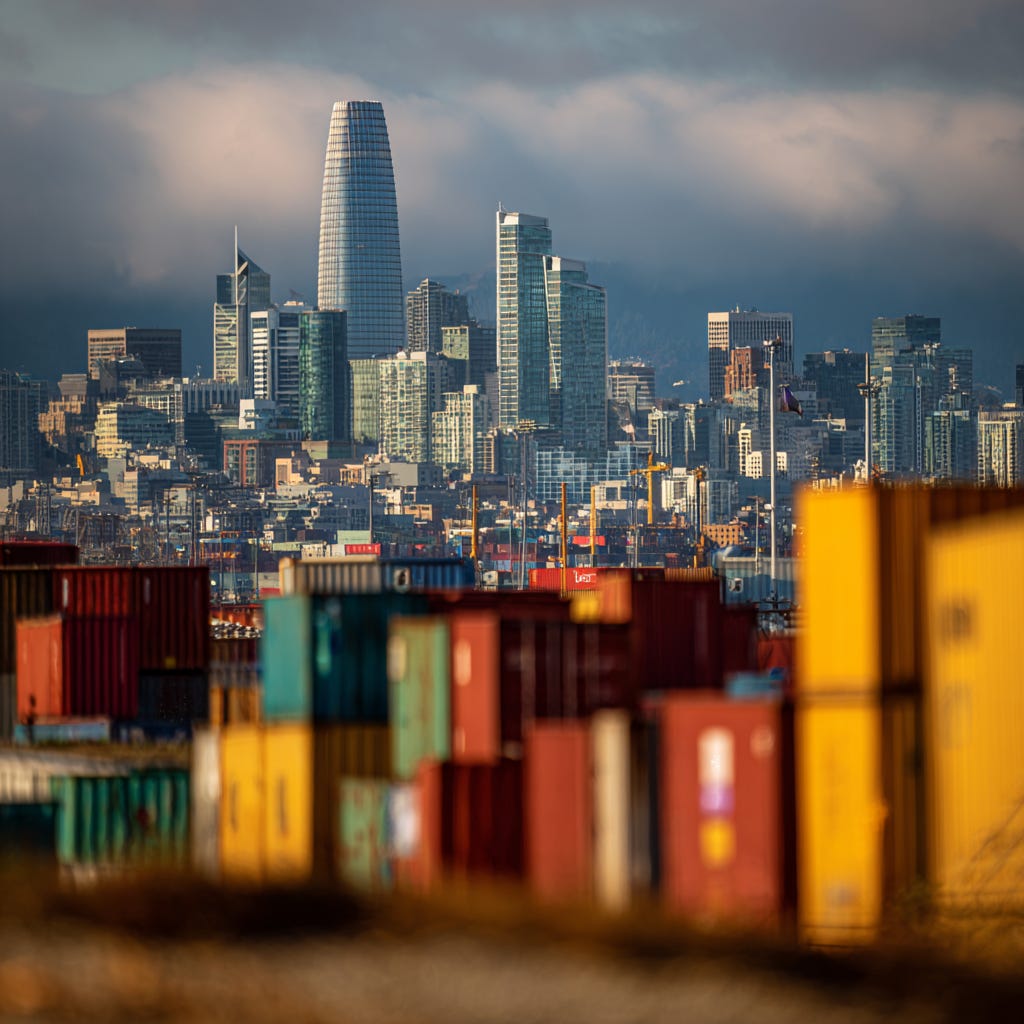
From the wraparound windows of my brother’s best friend’s mansion at the top of Twin Peaks, you can see the entirety of the Bay. Marin stands proud and green in the distance, with the lines of Golden Gate highlighted against her in Christmas red (officially called “International Orange). The Bay itself glitters in sunshine, broods in fog, and blinks from the lighthouse of Alcatraz island in darkness. The leggy cargo cranes of the Oakland Port that purportedly inspired George Lucas’ looming AT-ATs look unintimidating in the distance, and the massive cargo ships floating placidly back to China seem like toy boats. The pan-handle of Golden Gate Park, so massive on a map, is just a lean strip of trees from here, and the Presidio rising behind it in the distance, for all its landscaped wealth, just looks like a bunch of trees. If I step onto the wall-length balcony and walk all the way to the right, I can see straight down Market Street with its colorful tic-tac cars and movie set stop-lights, the whole thing somehow reminding me of a children’s show.
I find this view comforting. San Francisco’s global plans feel unreal from up here, receding into the quaint world of a postcard, or maybe a black-and-white movie where business tycoons are just douchey characters and the happy ending is pre-determined. From this safe seclusion, I watch things nearer to hand; the neighbors’ backyards sloping down the hill, where a woman walks her elderly mother to the car and workmen hammer on scaffolding; the hawks circling the cypress grove that pours, fountain-like, out of the hill upon which we sit. I particularly enjoy the returning raven who likes to hop on the ledge of the neighbor’s roof; he is for some reason always glistening wet and preening, even when it hasn’t rained. I think he takes dips in the nearby reservoir.
I’ve visited my brother three times this month while in town for Inkhaven, recovering from the insularity and, I realize now as I gaze out upon the city, the sense of my own powerlessness. In Berkeley, the city rises in the distance, and I am a marble rolling around a giant maze. Here, I can imagine I am safe from the future that is coming; I can imagine I am the one building it, and not the creature who will soon be caught in its gears.
As I’m musing, one of my brother’s roommates pops out of the kitchen and we strike up a conversation about the boats. I ask how long they tend to stay in port, and he says something like, “Too long, compared to China. They’re already automated, but the dock worker unions here don’t want to allow it.” He does an over-the-top southern hick accent, saying, “Don’t automate us!” as if only a retard would say such a thing. I raise my eyebrows and wryly ask if that might not be a bit of a cruel caricature, given they’re probably just trying to feed their families. He concedes, unoffendable, but notes, “They’re just not going to win.”
“That might be true. But it seems good somehow that they put up a fight.”
“Yeah? Maybe.”
“Maybe it’s condescending of me, but if they don’t even put up a fight, it’s like they never existed. Nobody knows they cared. It’s a way of letting everyone know what everyone else cares about, even if you’re doomed to lose. Sort of a cultural legibility thing.”
He bobs his head good-naturedly, swinging into the kitchen to get some coffee. “Might be, might be.”
“What do you do again?” I ask, wondering if he’s involved with automation or just making conversation. “Do you have a normal job out here, or a startup?”
“Startup CEO. We’re trying to sdfksjdlfksjldjf.”
It sounds finance-y. I ask a few more questions, and at some point he says, “Yeah, man, that’s my role in all this.”
“What?”
“I’m the guy with the goons who comes to kick the door down on the union workers,” he says, miming kicking a door down. “Like, I’m taking your jobs! I’m the villain.”
I blink, unsure what to make of this. Is this a preemptive defense against potential accusations, or just real sadism? He has a boyish, friendly energy, open and intelligent, and doesn’t read to me like a sociopath. He bops around, looking for his coffee.
Nothing like a direct question to start the day off right. “So…how do you feel about that?”
“What?”
“Being the villain.”
“I mean, I feel good about it. It’s just my role, like, the economy has got to run efficiently or there’s no growth. And I feel like economic efficiency is good.”
“Why is it good?”
“Well, two reasons. First–”
“I mean on a gut level,” I interrupt. “Like, if you had to name the gestalt of what you mean by “good,” what does it feel like to you personally?”
“Hmm.” He’s just finished microwaving his breakfast and is figuring out where to get situated in the gigantic living room so he can talk to me. “I don’t want this lamp here,” he murmurs to himself, shuffling around the desk. The living room table has been pushed back due to a giant party of STEM people who ate pizza and gave lightning talks here last night. He frowns, pushing two of the Victorian lamps together on the little table, where their shades displace each other dangerously, then grumbles. “If you’re going to throw a party, you have to put the house back together afterwards...” Finally, he settles on placing the extra lamp on the floor. “Yeah. I mean, honestly,” he says, “Honestly, I can make a lot of money.”
We make eye contact maybe for the first time and I sort of chuckle.
“Yeah.” He laughs. “I can make a lot of money doing this.”
“Simple as that, huh.” It’s quite for a minute while he eats his burrito. Nothing like a direct question…
“Do you feel any responsibility for them?” I ask.
“For them?” he asks, suddenly energized. “Yeah! I mean, like, it’s terrible. They’re fucked. They’re getting totally fucked by like the government, big businesses.” I’m surprised by this seemingly contradictory response even as I notice that what he’s expressing is clarity or possibly empathy, but not responsibility.
“Does that bother you? That they’re getting fucked?”
“Yeah it’s bad. It’s really bad. But I mean, look. You know the concentric circles of care? You seen that map? Like, there’s all sentient life, then all human beings, then like your country, then your town or tribe and then like your friends and family and then you? Like that thing they talk about on the right? But where people on the left care about people across the world? So like, my circle of care is really tiny.”
“You really are a Texan,” I say wryly.
He laughs. He likes that. “I really am. So like, I basically only care about the people very close to me. If it’s the dock workers or the people I care about, I got no problem kicking their door down. Like, those people don’t matter if it comes down to it. I’m gonna take their shit and run.”
Sometimes I can’t turn off my “auto mirroring” mechanism, built from years as a life coach. “So…it’s about taking care of your own. It’s about your people.”
“Yeah!” he says right away, and he seems happy to be understood. His voice is slightly warmer than it was a minute ago, though I don’t think he notices this.
“It does seem like it’s premised on a zero-sum perspective though, right?” I push. “Like, what if it’s not either-or?”
I can almost feel his literal-minded economics brain light up. “Well, I mean– either the dock workers are automated or they’re not—”
“Yeah, yeah, true, but I mean…larger than that. Like sure, in that literal case it is zero sum. But you aren’t literally engaged in automation. Like, if you’re making a lot of money that costs other people their jobs, couldn’t you, I dunno, help offset it somehow? If you cared to do so?”
“Yeah I dunno.” His mind feels slippery somehow, like it’s going somewhere it doesn’t usually go. Then it snaps back. “Have you heard of Jevons’ Paradox?”* I shake my head. “There was this scientist here last night (who is probably gonna like, win a Nobel Prize in a year or two for his work on this), he has this idea of Automation Augmentation.** Basically his work is on how automation often ends up actually creating more jobs.”
I’m confused. I thought this thing was “good” to him because it was good for him personally and for his people and he doesn’t give a shit about anyone else, but now it sounds like he’s trying to sell me on this model in which it’s actually gonna be good for everyone. I still like him, I notice, even though he seems a little fractured in his rationalizations. He’s oddly buoyant, good-natured and friendly for a self-identified villain. And there’s something interesting about what he’s saying.
“So….where I’m coming from,” I throw in, apparently deciding to open up, “Like, I work with people doing coaching. I have a very– a very empathetic heart. I was in a cult, so I also have boundaries–” he laughs, in surprise, but also I think in recognition; cults and cult-like groups are nearly a dime a dozen in California— “—but basically, I feel very concerned about how all this is going to affect people. My heart— hurts.” I’m surprised to hear my own phrasing. “I care a lot about easing this process for people. Like, I don’t have all the power here, but to the extent that I could conceivably do something, it feels like my business.”
“I mean, that’s good. We need people like you to counteract people like me.”
Now I laugh in surprise. “Is that so?”
“Well like, you need sharks in the ecosystem, you know?” he says, digging back into his burrito. “If you don’t have sharks eating all the little garbage fish, the whole thing stagnates. It gets all fat and slows down, no growth. You can’t have it so the entire economy doesn’t work. Efficiency is good. But like, you also need the things that fight the sharks, or at least keep them from completely taking over. Maybe that’s you.”
“Maybe….” Something about this felt awfully neat. “There’s a question of how much each individual is responsible for paying attention to in the ecosystem– like, just their own turf? Or the whole?” I take a sip of my coffee, thinking. “I dunno. Okay, take an individual psychological frame, because that’s where a lot of my work is. If things happen too fast or too confusingly for people, if our lives change too suddenly in some way, we tend to leave parts of our psyche behind. I know, because I’m the one talking to people ten years later and helping them find those parts and get them integrated again.”
He seems pretty engaged with this line of thought, nodding over his breakfast. “Okay.”
“I’ve found that any part of a human mind that gets crushed or dominated or cut off or dismissed, it doesn’t go away. It just stays there, and it pops up in a million weird ways that aren’t conscious. Like, why is that guy acting so weird at that party around women? It’s some desire he can’t see, something that got lost, something living in his shadow. He cut it off or lost it but it’s still in him, it’s still acting on the world whether he knows where it comes from or not.”
“Yeah. Interesting.”
“And I think I’ve come to see society this way; like a giant mind. Everything is everybody’s business, at least over long time scales, because everything affects everything. And any part of society that gets crushed or oppressed or violated in some way, it eventually comes back to bite us all in the ass. Not always in a direct way– sometimes we lose track of the lineage of cause and effect– but nothing gets lost. So it seems to me like– like– I try to take a dialectical approach. So it seems to me I want to help the world maintain some kind of balance through major change, for this reason. Everything is interconnected. What one group does now will affect all the other parts of the system, and they’ll come back and affect that first group eventually, indirectly, somehow, at some point. Butterfly effect, I guess.” I don’t know how to communicate this idea that one moment’s wild success is just a pendulum swing that will eventually even out; that one group’s momentary domination, even if that takes place over a few hundred years, will eventually swing back another way, because the experiences of those they’ve dominated don’t disappear from the universe; they just…lie in wait. I realize vaguely that I’m sort of describing karma? “Not in a punishing way,” I add hurriedly, half to him and half to myself. “But maybe we can sort of….keep an eye on things and care for all the parts of the system. Aim for balance. Just trying is liable to make the transition easier than not trying at all.”
I take a big breath and a slug of coffee, a little surprised to hear my own thoughts aloud. He seems surprisingly excited by this perspective, and says a bunch of things about how much sense this makes, how people do things that don’t make sense all the time. Is that what he got from this? I’m figuring out how to clarify my perspective when he throws out, “Have you heard of the concept of auto-correlation?”
“No.”
“So it’s an idea in economics. It’s when a thing’s current value or performance correlates to what will happen later. It’s like feedback loops. So, auto-correlated things will either form an exponential graph or, if there’s a hard limit somewhere, an S curve.”
“So like, investments? How much you have now is in a feedback loop with how much you’ll have in a month, which then keeps feeding into future loops…”
“Exactly! Yeah.”
“So….what I said made you think of that?”
“Yeah!”
Interesting. Maybe I am saying that what a few of us do right now as a civilization is correlated with how we all do later; or maybe, how I do is correlated with how you do. How this guy does in business is correlated with how the dock workers do; but also, how well the dock workers flourish is correlated with how well he is going to flourish, at least over time, in some indirect way. It must be, because their suffering will not simply disappear into black matter. It will remain powerful to the exact degree it is felt, and transmute into either something positive or something terrible. It’s funny to see this boyish Texan with his fast, sharp mind using economics terms to describe spiritual truths like interconnection and karma. It’s funny to find that my authentic thoughts even have anything to do with those ideas. I wasn’t conscious of that.
I suddenly think of the last time I went to the ocean, and what I heard when I asked for wisdom. I do that sometimes. I don’t always get an answer, but I did that day. “Remember,” something inside me said very simply, “it’s all connected.” It was such a seeming platitude that I wondered if I had simply made up the first thing that popped into my head. But it had that quality of intuition, that quality that says, without justification or preamble, this is right. It said, Remember; it’s all connected, and that message was right; it was the right message for me, right at that moment, and I knew it was good for me to hear even if I didn’t immediately know why. It hit me in my fear around place; all these cities I’m spending time in as a nomad, all these lives I live that feel fractured from one another, they are actually connected through oceans which touch each other, airplanes which carry the same people from one city to another, rain cycles which bathe my parents in the Midwest with water from the Oregon valleys. It hit me in my fear around time; I feel my youth slipping away into a world that’s being built so fast my grieving process can’t keep up, but the past and the future are inextricably tangled up. Whatever comes will carry with it the imprint of what has been, just as I was born into a world layered with meaning and history not my own. And it hit me in my body, which immediately sank more heavily into the sand with a sense of cosmic calm.
So it felt like a good message for me. Remember, it’s all connected. And here is this guy, this startup CEO, trying it out in his own language. Remember; we are all auto-correlated with each other.
And so, I think, we are.
*I’m not sure this is the real paradox he named.
**I’m not sure this is the real principle he named.
Loved this essay, really enjoyed the feeling of dropping into an interesting and earnest one on one convo. We all should have more of those! And also enjoyed the economics lesson in the comments 🤣
This was an interesting read, mainly as a window into how two different people who both clearly do not understand economics relate to economic questions.
I think basically-all of my closest friends would have responded to the opening bit - "But it seems good somehow that [the dockworkers] put up a fight" - with "no, that's rent-seeking, it is Wrong to force people to buy a product (e.g. dockwork) from me when they could get it cheaper and better somewhere else. If that means I need to get a different job, then I need to get a different job, not force people to buy from me just for my benefit and their cost".
... and it is useful to occasionally hear how other people emotionally relate to these things, to keep my models of median humans up-to-date.